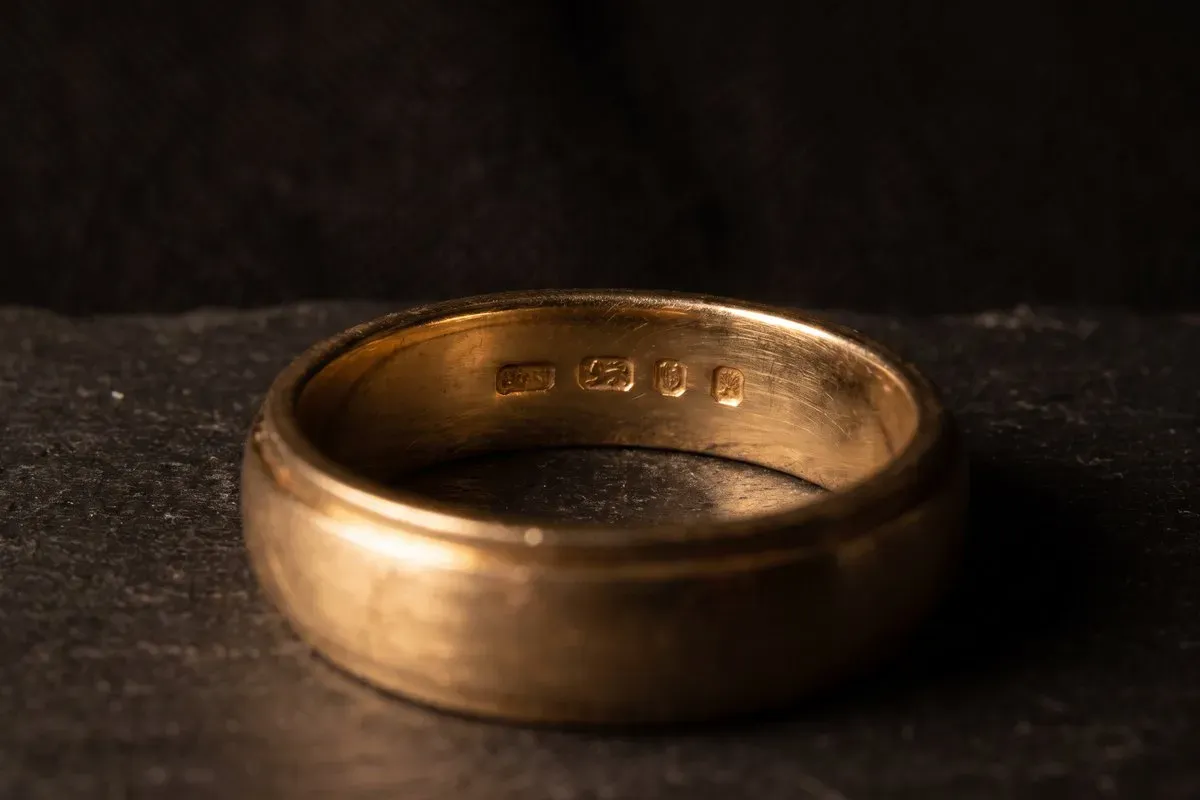
A hallmark is easy to miss. It is small, usually tucked inside a band or on the clasp of a chain, and most people never look for it. It is worth knowing what it says, because a hallmark is far more than decoration: it is a legal guarantee of the precious metal content of a piece, and a record of who made it and where it was tested.
The three compulsory marks
Every UK hallmark carries three compulsory marks. The first is the sponsor's mark, the maker's or company's initials inside a small shield. The second is the millesimal fineness mark, which states the metal content as parts per thousand: 375 for 9ct gold, 750 for 18ct gold and 950 for platinum. The third is the assay office mark, which shows where the piece was tested, and Birmingham's mark is an anchor. Read together, the three tell you the maker, the metal and the office that checked it.
The optional marks
Alongside those three there are optional marks. A traditional fineness symbol may be added, such as a carat mark or a scale for platinum. A date letter can record the year the piece was assayed, and many older pieces carry one that helps to place them in time. These extra marks are not required by law, but they add detail, and a collector will often look for them first. They can also help you spot a repair or a later addition, since marks added at different times rarely sit evenly together.
A hallmark is not the same as a maker's stamp or a brand name. It is applied by an independent assay office rather than by the jeweller, and it is a statement of fact rather than a mark of quality or design. Two pieces with identical hallmarks may be very different in value, because what the hallmark guarantees is the metal, and nothing beyond it. Hallmarks have been struck in Britain for centuries, and Birmingham's assay office dates back to 1773. The system protects the buyer, which is why a piece of gold can be trusted by weight as well as by eye.
Small pieces, and our promise
The law allows some very small pieces to go without a hallmark. Gold under one gram and platinum under 0.5 grams need not be marked, since there is little room for the punches and a very small piece would be spoiled by them. Even so, Elsworth hallmarks every piece it can, so you can read the fineness, the maker and the assay office for yourself.
If you are unsure what you are looking at, bring the piece to either salon. We will read the marks with you and explain what each one means, whether it was made by us or by another house. A small lens and a steady hand are all it takes, and it is one of our favourite things to do for a client. Bring it in with your questions and we will take as long as you need.